
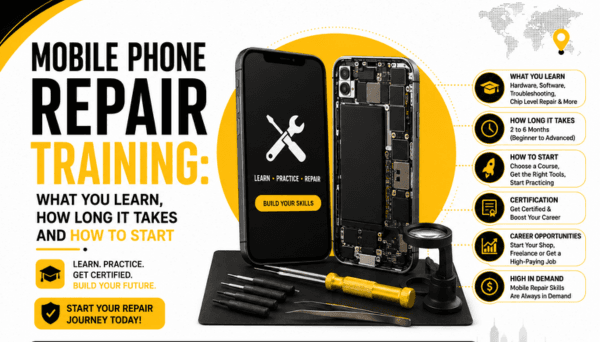
Mobile phones have become the digital nervous system of modern life. We rely on them for everything from daily banking and work communications to priceless family photos. Because of that constant reliance, skilled repair technicians are in high demand. But making the leap from someone who uses a smartphone to someone who can confidently tear one down, trace a motherboard fault, and rebuild it requires a clear roadmap.
Explore Mobile Phone Repair Training
Whether you're looking to start a fresh career, add high-margin repair services to an existing tech business, or master the intricate craft of microsoldering, let's break down six big questions people ask before diving into mobile phone repair training.
What do you learn in a mobile phone repair course?
A solid phone repair course goes far beyond basic "screw-driver-and-suction-cup" YouTube tutorials. While replacing a cracked screen or an aging battery is a great starting point, real technical training focuses on understanding why a device fails and how to fix it safely without causing secondary damage.
A well-rounded training curriculum covers:
- Safe disassembly and reassembly: Mastering heat-application techniques, managing tiny screws of varying lengths (avoiding "long-screw damage" to motherboards), and preserving water-resistance seals.
- Component-level replacements: Swapping out displays, charge ports, battery cells, camera modules, flex cables, and internal speakers.
- Systematic diagnostics: Learning how to use multimeters and DC power supplies to pinpoint whether a dead phone suffers from a bad battery, a blown charge port, or an active motherboard short.
- Motherboard fundamentals: Reading schematics, identifying power management ICs, understanding board layouts, and tracing circuit paths.
- Advanced micro-welding: Hands-on microsoldering under a microscope to repair torn pads, swap tiny surface-mount chips, and fix board-level faults.
- Data recovery techniques: Salvaging photos and personal files from severely damaged, bent, or water-damaged logic boards.
At PRC Repair, the training structure is designed to take students from basic modular part replacements all the way up through complex board-level diagnostics and data recovery.
How long does it take to learn mobile phone repair?
There isn't a single universal timeline because "repair" spans everything from quick 15-minute screen swaps to multi-hour motherboard rebuilds.
Your learning journey breaks down depending on your specific goals:
- Modular Repairs (1 to 2 Weeks): Learning basic mechanical skills—like changing iPhone screens, replacing Samsung batteries, and clearing physical port debris—can be learned through intensive, structured hands-on training relatively quickly.
- Advanced Diagnostics & Software (A Few Months): Learning how to troubleshoot tricky intermittent faults, use diagnostic software, measure board voltages, and manage varied multi-brand hardware takes steady practice across dozens of real-world devices.
- Microsoldering & Motherboard Repair (6+ Months of Practice): Board-level repair is a fine-motor skill. Understanding circuit schematics, mastering heat control on hot-air stations, and working under high magnification requires persistent hands-on bench time to build true muscle memory.
PRC Repair structures its training programs in progressive modules, allowing you to master basic physical repairs first before deciding to level up into advanced microsoldering.
Do you need experience to learn phone repairing?
Not at all. You don't need a degree in electrical engineering or prior bench experience to start learning phone repair.
The most important traits when starting out are steady hands, decent patience, good spatial awareness, and a methodical mindset. Modern smartphones are densely packed puzzles. When you first look inside a flagship phone, the rows of tiny connectors, fragile ribbon cables, and microscopic screws can feel overwhelming. But with proper guidance, opening a $1,500 phone becomes a calm, routine process.
If you’re completely new to electronics, starting with basic mechanical teardowns gives you a solid foundation before you ever touch a soldering iron or a schematic diagram.
What tools do you need to become a phone repair technician?
Having the right tools is the difference between a clean 20-minute repair and a ruined motherboard. Using cheap, soft-metal screwdrivers can strip tiny internal screws, while uncontrolled heat guns can easily scorch delicate OLED screens.
A foundational technician setup includes:
- Precision screwdrivers: High-quality Pentalobe, Tri-Point, Phillips, and Standoff drivers built with hardened steel tips.
- Pry tools and tweezers: Anti-static nylon spudgers, ultra-fine curved tweezers, and thin flexible opening picks.
- Heat pads and thermal guns: Controlled heating equipment to safely soften stubborn display and back-glass adhesives.
- Diagnostic equipment: Digital multimeters, USB ammeters, and DC bench power supplies to measure current draw.
For advanced board work, your workbench setup evolves significantly:
- Trinocular stereo microscopes: Essential for seeing microscopic components and solder joints clearly.
- Precision soldering stations and hot-air rework stations: For micro-pumping heat onto specific chips without blowing neighboring components off the board.
- Board holders and specialized flux: Keeping double-stacked motherboards steady while working under high heat.
Learning how to set temperatures, select airflow nozzles, and calibrate your multimeter is just as critical as buying the gear itself.
How do you learn microsoldering for phone motherboard repair?
Microsoldering is considered the elite skill tier in mobile phone repair. It allows you to fix phones that other shops turn away as "unrepairable" or "write-offs."
Instead of replacing an entire expensive logic board, a microsoldering technician works under a microscope to replace a tiny $2 chip, rebuild torn copper pads, or jump broken circuit traces thinner than a human hair.
Mastering microsoldering involves learning to:
- Read and interpret board schematics and interactive software (like ZXW or JCID).
- Identify board components like capacitors, resistors, diodes, filters, and IC chips.
- Use hot-air stations precisely to remove liquid-damaged or shorted chips without overheating the board.
- Clean, reball, and solder new surface-mount components back onto microscopic pads.
- Diagnose and repair backlight circuits, touch IC failures, and charging line shorts.
This is a physical skill that simply can't be learned solely by reading books or watching videos online. You need real bench time with actual motherboards, feeling how solder flows and learning how heat transfers through different layers of copper.
PRC Repair provides specialized microsoldering courses equipped with professional bench setups, allowing you to practice these high-level techniques under expert supervision.
Learn Microsoldering with PRC Repair
What skills do you need to start a mobile phone repair business?
Technical mastery is only half the battle if your goal is to open a store or launch a mobile repair service. Running a successful repair business requires blending clean technical work with strong business management.
To build a thriving repair operation, you need:
- Diagnostic efficiency: Finding the root cause quickly so you can give accurate quotes.
- Parts sourcing and quality control: Knowing how to source reliable, high-grade replacement screens and batteries while avoiding cheap knockoffs that lead to customer returns.
- Customer communication: Translating complex technical issues into clear, plain language so customers understand what they're paying for.
- Data privacy and ethics: Handling devices loaded with sensitive personal photos, banking apps, and private messages with complete professionalism and integrity.
- Basic business operations: Managing repair ticketing systems, inventory, warranties, and local marketing.
Trust is the single most valuable asset in the repair industry. When customers know you can fix their device quickly, protect their data, and stand behind your work with a fair warranty, they become loyal clients for life.
Learn Mobile Phone Repair with PRC Repair
If you're ready to gain practical, real-world repair skills, PRC Repair offers hands-on training programs designed for every stage of your journey.
Whether you are starting from total scratch or looking to expand your existing tech skills into motherboard diagnostics, microsoldering, and advanced data recovery, training with experienced technicians shortens your learning curve dramatically. Rather than relying on trial and error with expensive customer devices, you get to build confidence on dedicated training boards and test equipment.
Start Mobile Phone Repair Training
Why Choose Practical Phone Repair Training?
Electronics repair is inherently tactile. You can memorize circuit theory all day, but you can’t master the exact amount of downward pressure required to disconnect a fragile FPC connector without actually feeling it in your hands.
Practical, lab-based training teaches you how metal flexes, how adhesives react to heat, how liquid flux flows, and how to systematically isolate hardware faults under expert guidance. That hands-on experience builds the muscle memory and confidence you need to work on high-value customer devices without hesitation.
Start Building Your Phone Repair Skills
You don't need to know everything on day one. Every master technician started by opening their very first phone, making small mistakes, learning the fundamentals, and steadily building their skillset over time.
By starting with core mechanical repairs, mastering device diagnostics, and progressively stepping up to advanced techniques like microsoldering and board repair, you can build a highly rewarding, recession-proof skill set.
If you're serious about taking the next step toward a career in tech repair or starting your own business, PRC Repair provides practical mobile phone repair training in Australia to help you get started on the right foot.
Express Phone Repair & Protective Accessories Near Me: Western Sydney & North West Sydney
Looking for fast, walk-in phone repairs or durable device protection near Sydney & Surrounding Suburbs? Phone Repair Centre operates two dedicated Sydney locations: our flagship diagnostic laboratory at 122 Queen Street, St Marys, and our express kiosk at Schofields Village. We combine 30-minute hardware fixes with complimentary bubble-free screen protector application and premium mobile accessories in stock every day.
Express Walk-in Repairs (30 to 45 Mins)
- Screen & OLED Replacement: iPhone, Samsung Galaxy, Google Pixel, and iPad display renewals with True Tone preservation.
- Battery Renewal: High-capacity replacement cells installed same-day with store warranty.
- Charging Port & Audio Fixes: USB-C and Lightning port cleaning, debris removal, or micro-soldering replacement.
- Laser Back Glass Repair: Clean rear glass replacement with factory-tight seal alignment.
- Strict Zero Data Loss: Your photos, banking apps, and personal data stay untouched throughout the repair.
In-Store Protection & Accessories
- Free Screen Protector Fitting: 9H tempered glass, anti-peeping privacy protectors, and hydrogel films applied bubble-free by our technicians.
- Drop-Proof & MagSafe Cases: Shock-absorbent military-grade covers, crystal-clear cases, and magnetic wallet folios for all popular models.
- High-Speed Power & Cables: 20W to 65W Power Delivery (PD) wall adapters, braided USB-C and Lightning cables, and magnetic wireless car mounts.
- Camera Lens Armor: Scratch-resistant sapphire glass lens protectors for multi-lens camera systems.
- Cash Buyback Desk (St Marys): Cash on the spot for unwanted, broken, or locked phones if you prefer to trade in rather than repair.
Drive Times & Proximity Catchment
St Marys Workshop (Western Sydney Hub):
• Penrith: 10 mins via Great Western Highway
• Mount Druitt: 6 mins via Carlisle Avenue
• Blacktown: 15 mins via M4 or Great Western Highway
• St Clair & Erskine Park: 7 mins via Bennett Road
Schofields Express (North West Sydney Hub):
• Rouse Hill & The Ponds: 6 to 8 mins via Schofields Road
• Tallawong & Box Hill: 5 to 9 mins via Boundary Road
• Marsden Park: 8 mins via Richmond Road
• Kellyville & Stanhope Gardens: 10 mins
Quick Answer: Where can I find phone repair and screen protectors near me in Sydney & Surrounding Suburbs?
Phone Repair Centre offers same-day walk-in repairs and professional bubble-free screen protector fitting across Sydney. Visit our flagship repair lab at 122 Queen Street, St Marys (near Penrith and Mount Druitt) or our express kiosk at Schofields Village (near Rouse Hill and The Ponds). Most repairs are completed in 30 to 45 minutes with zero data loss and store warranty included.