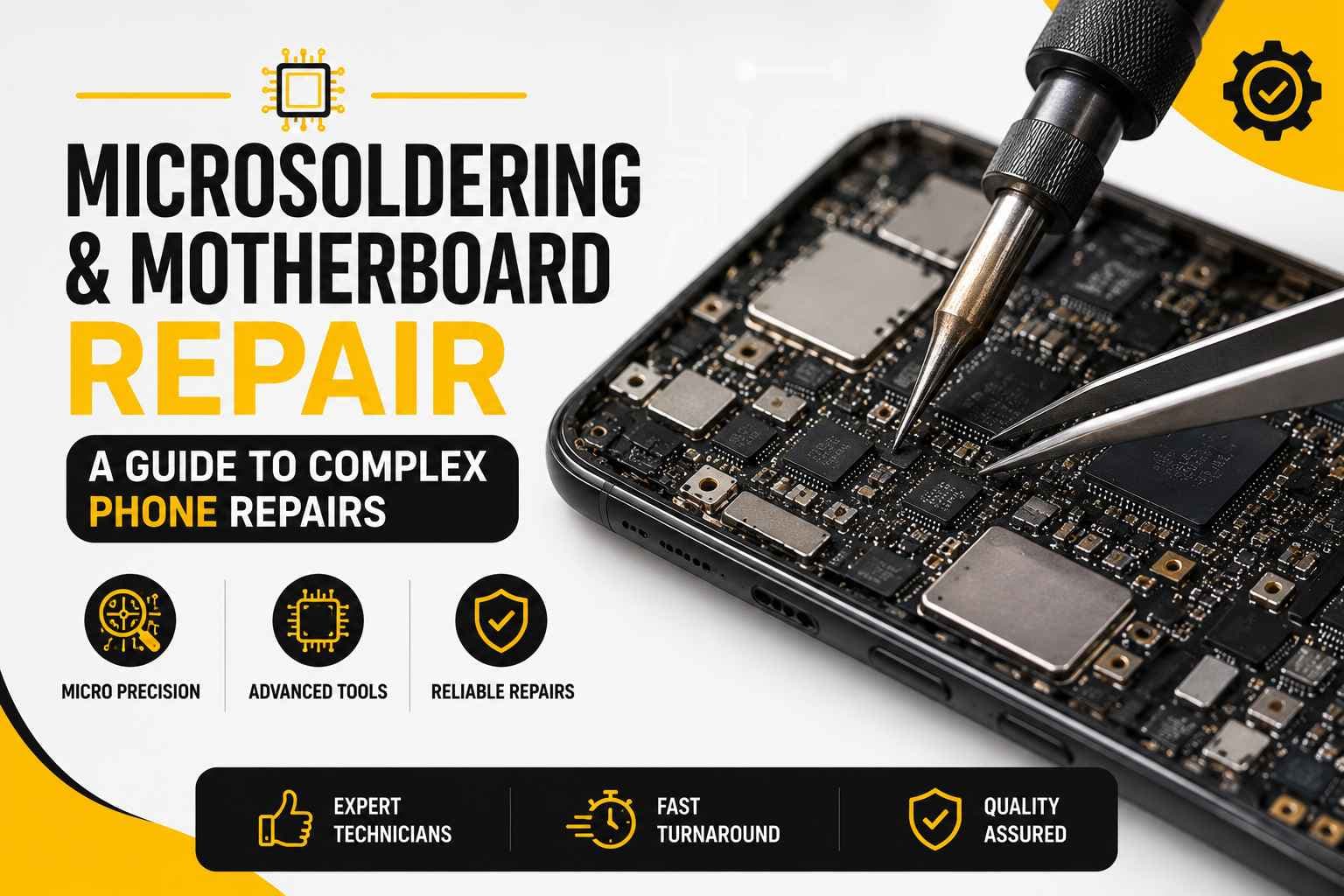
When a phone completely dies, the immediate panic usually sets in fast. You plug it into three different chargers, try a hard reset until your thumbs hurt, and nothing happens. Standard repair shops might swap out the screen or toss in a new battery, but if the device remains lifeless, they'll often hand it back with a sad shake of the head and tell you it's a "dead motherboard."
In the traditional repair world, that used to be the end of the line. But a dead logic board doesn't actually mean the phone belongs in the bin.
At PRC Repair, we specialize in the intricate world of microsoldering and board-level restoration for phones, iPads, gaming consoles, MacBooks, and other electronics. Instead of writing off an entire device over a single failed micro-component, our technicians work under high-powered magnification to find the exact circuit fault and fix it right on the board.
Explore Microsoldering Services
Can a damaged phone motherboard be repaired without replacing it?
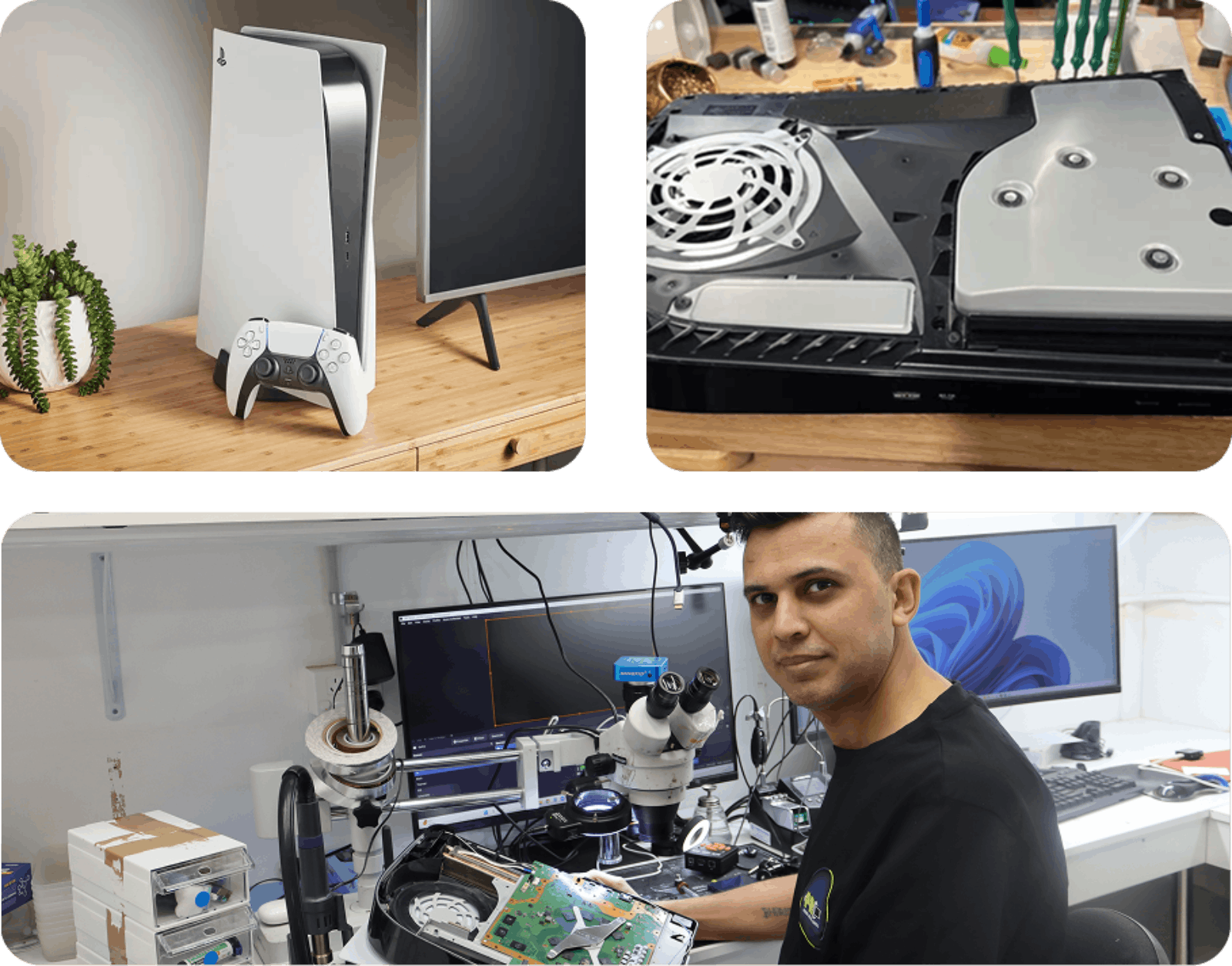
Yes, in many cases a damaged motherboard can be repaired without throwing the whole board away.
A smartphone logic board is essentially a tiny, dense city of interconnected micro-components: capacitors, resistors, diodes, power management ICs, and complex silicon chips—all linked by microscopic copper traces. When a phone stops working, it's rarely the entire board that failed; usually, it's just one tiny component smaller than a grain of rice that took a hit.
Board-level repairs address common hardware failures like:
- Complete power loss (dead phones)
- Total charging failure or fake charging
- Endless boot-looping on startup logos
- Blown charging IC chips (Tristar/Hydra issues)
- Short circuits on main power rails
- Damaged FPC connectors torn during previous repair attempts
- Liquid corrosion eating through board traces
- Specific Face ID or sensor circuit disruptions
The biggest advantage of component-level repair is surgical precision. Replacing an entire motherboard often costs as much as buying a replacement phone, and it completely wipes your local data. Fixing the specific failed chip on your original board keeps your costs down and keeps your data right where it is.
Needless to say, this isn't a DIY job you can tackle with a hardware store soldering iron on your kitchen table. It takes specialized thermal cameras, micro-tweezers, hot-air rework stations, and steady hands under a microscope.
Why does my phone show no power after a charging issue?
It’s a scenario we see on the bench constantly: your phone was acting finicky on the charger for a few days, and then suddenly, total blackness.
When a charging issue turns into a complete power failure, the damage has usually traveled up the chain from the physical charging port and hit the logic board's power-management circuit.
Common causes include:
- Physical damage inside the USB-C or Lightning port
- A blown main charging controller IC
- A fried primary Power Management IC (PMIC)
- Shorted filtering capacitors near the battery terminal
- Burned circuit traces from a power surge or cheap car charger
- Internal liquid ingress corroding the charging lines
- Board flex from a hard drop breaking micro-solder joints
- Complete battery cell shutdown
If your phone stops taking power, stop repeatedly plugging in high-wattage fast chargers to force it to turn on. If there's a shorted capacitor on the board, constantly pumping high amperage into it can turn a small, isolated repair into a burned-up circuit board.
We test the power rails directly using precise DC power supplies to locate where the current stops flowing and replace the specific failed chip.
Can microsoldering fix an iPhone that won't turn on?
Absolutley. Microsoldering is often the only thing that can bring a completely unresponsive iPhone back to life.
When an iPhone won't turn on, the battery itself is rarely the real culprit. iPhones have intricate power-sequencing circuits. If a single tiny capacitor on the main power line (VCC_MAIN or VDD_MAIN) shorts to ground, the phone's safety systems immediately lock down and refuse to feed power to the rest of the board. To the user, it looks like a completely dead brick.
Under a microscope, a technician can use a thermal imaging camera to watch the logic board as power is injected. The shorted component will glow hot instantly, revealing its exact location.
From there, we carefully desolder the damaged micro-component, clean the pad, solder a fresh replacement in place, and restore the complete power rail. If you have years of unbacked-up family photos or critical work files on that iPhone, micro-soldering the original board is usually the only way you'll ever see that data again.
Get iPhone Microsoldering Repair
What causes a phone motherboard to stop charging?
When a phone refuses to take a charge, everyone immediately blames the charging port. But the port is just the doorway—the actual traffic controller lives deeper inside the motherboard.
Logic board charging failures are usually caused by:
- Charging IC Failure: The dedicated chip that regulates power input gets overloaded and burns out.
- PMIC Breakdown: The main power management chip loses its ability to communicate with the battery.
- Third-Party Cable Surges: Cheap, uncertified charging cables that lack voltage-spike protection sending raw voltage spikes directly into delicate board circuits.
- Pin Bridges & Corrosion: Water or metal debris causing pins inside the port or on the board connector to bridge together and short out.
- Fractured Traces: The physical strain of plugging and unplugging tearing tiny copper lines right off the board.
If the issue is just a clogged or bent port, a straightforward modular repair will fix it. But when the phone claims it's charging while the battery percentage steadily drops, or when it won't pull any current at all, micro-soldering component replacement is what gets the power flowing correctly again.
Repair Charging & Motherboard Issues
Can a water-damaged phone motherboard be repaired?
Yes, water-damaged logic boards can often be saved, provided you handle the situation correctly right after the spill.
When liquid hits an active circuit board, it immediately creates short circuits between tiny component pins. Over the following hours and days, the minerals in the water react with the electrical current, creating green and white corrosion that literally eats through thin copper traces and metal chips.
If your phone takes a dive:
- Power it down immediately and leave it off.
- Unplug any charging cables right away.
- Resist the temptation to turn it back on "just to see if it works."
- Skip the bag of uncooked rice (it doesn't remove internal moisture and leaves behind a dusty, corrosive starch paste).
- Get it straight to a technician equipped for board-level liquid restoration.
Our liquid damage recovery process involves stripping the logic board down completely, running it through specialized ultrasonic cleaning baths to scrub away corrosion underneath chip shields, micro-soldering replacement components onto any damaged circuits, and rebuilding destroyed traces under high magnification.
Can phone data be recovered from a damaged motherboard?
In most cases, yes. The memory chip containing your photos, messages, contacts, and files is surprisingly tough—it's usually the supporting power circuits around it that fail.
A phone that won't turn on or display anything doesn't mean your data is gone. As long as the central storage chip (NAND) and the main CPU haven't been physically cracked in half or fried by a catastrophic electrical event, we can almost always retrieve your files.
This is where repair and data recovery overlap. We don't necessarily need to make the phone look pretty or fix every single secondary function like camera or Bluetooth. Our primary goal during board-level data recovery is to repair the main power and display rails just enough for the board to boot up, accept your passcode, and let us back up your data safely onto an external drive.
Because factory resets and aggressive software flashing wipe storage chips permanently, you should always seek a proper hardware assessment before attempting software-level fixes on a dead phone holding valuable data.
Explore Data Recovery Services
Why Choose PRC Repair for Microsoldering and Motherboard Repairs?
Micro-soldering requires a completely different skill set, toolkit, and environment compared to routine screen swaps.
At PRC Repair, we handle complex micro-soldering and motherboard work completely in-house:
- Advanced microscope-assisted diagnostic stations
- Thermal imaging camera short-detection systems
- Precision micro-soldering and chip rework equipment
- Dedicated charging IC and PMIC replacements
- Logic board short-circuit repair and trace rebuilding
- Deep ultrasonic liquid damage restoration
- Specialist iPhone, iPad, and Samsung board repairs
- Hardware-level forensic data recovery
Because we don't outsource our board work to third-party facilities, your device stays under one roof, cutting down turnaround times and keeping your personal data secure throughout the entire repair process.
Explore PRC Repair Microsoldering
When Standard Repairs Aren't Enough
Imagine a customer bringing in a phone that took a hard fall onto concrete. It won't turn on and won't charge. A standard repair shop tries a fresh display—nothing. They try a new battery—still nothing. They swap the charging port assembly—complete silence.
At most shops, that's where the repair effort ends.
On our bench, that's where the actual diagnosis begins. We pop the board under the microscope, hook it up to a DC power supply, and check the power rails. Within a few minutes, we locate a cracked inductor or a shorted capacitor thinner than a human hair that snapped during the impact. A few minutes under the hot-air station with fresh solder, and the phone powers back up like nothing ever happened.
Send Your Device for Assessment
Final Thoughts
A dead logic board or a severe charging fault doesn't mean your phone is ready for the scrap heap.
Before you write off a dead device, pay for a costly total board replacement, or give up on irreplaceable personal memories, get the hardware assessed by a board-level specialist. Most micro-component failures can be diagnosed and repaired cleanly, giving your device—and your data—a genuine second chance.
Express Phone Repair & Protective Accessories Near Me: Western Sydney & North West Sydney
Looking for fast, walk-in phone repairs or durable device protection near Sydney & Surrounding Suburbs? Phone Repair Centre operates two dedicated Sydney locations: our flagship diagnostic laboratory at 122 Queen Street, St Marys, and our express kiosk at Schofields Village. We combine 30-minute hardware fixes with complimentary bubble-free screen protector application and premium mobile accessories in stock every day.
Express Walk-in Repairs (30 to 45 Mins)
- Screen & OLED Replacement: iPhone, Samsung Galaxy, Google Pixel, and iPad display renewals with True Tone preservation.
- Battery Renewal: High-capacity replacement cells installed same-day with store warranty.
- Charging Port & Audio Fixes: USB-C and Lightning port cleaning, debris removal, or micro-soldering replacement.
- Laser Back Glass Repair: Clean rear glass replacement with factory-tight seal alignment.
- Strict Zero Data Loss: Your photos, banking apps, and personal data stay untouched throughout the repair.
In-Store Protection & Accessories
- Free Screen Protector Fitting: 9H tempered glass, anti-peeping privacy protectors, and hydrogel films applied bubble-free by our technicians.
- Drop-Proof & MagSafe Cases: Shock-absorbent military-grade covers, crystal-clear cases, and magnetic wallet folios for all popular models.
- High-Speed Power & Cables: 20W to 65W Power Delivery (PD) wall adapters, braided USB-C and Lightning cables, and magnetic wireless car mounts.
- Camera Lens Armor: Scratch-resistant sapphire glass lens protectors for multi-lens camera systems.
- Cash Buyback Desk (St Marys): Cash on the spot for unwanted, broken, or locked phones if you prefer to trade in rather than repair.
Drive Times & Proximity Catchment
St Marys Workshop (Western Sydney Hub):
• Penrith: 10 mins via Great Western Highway
• Mount Druitt: 6 mins via Carlisle Avenue
• Blacktown: 15 mins via M4 or Great Western Highway
• St Clair & Erskine Park: 7 mins via Bennett Road
Schofields Express (North West Sydney Hub):
• Rouse Hill & The Ponds: 6 to 8 mins via Schofields Road
• Tallawong & Box Hill: 5 to 9 mins via Boundary Road
• Marsden Park: 8 mins via Richmond Road
• Kellyville & Stanhope Gardens: 10 mins
Quick Answer: Where can I find phone repair and screen protectors near me in Sydney & Surrounding Suburbs?
Phone Repair Centre offers same-day walk-in repairs and professional bubble-free screen protector fitting across Sydney. Visit our flagship repair lab at 122 Queen Street, St Marys (near Penrith and Mount Druitt) or our express kiosk at Schofields Village (near Rouse Hill and The Ponds). Most repairs are completed in 30 to 45 minutes with zero data loss and store warranty included.